When nature writes its own plan
A story about 350 trees, great expectations, disappointment and the realisation that nature does not always follow our wishes.
When we started creating Lunina dolina, we had lots of ideas and plans, and above all a sincere wish to gradually give more life back to land that had been used for conventional farming for many years.
One of our first big decisions was to turn part of the former field into a diverse planting of fruit and forest trees.
We did not want an ordinary orchard with just one or two kinds of trees planted in even rows. We wanted something richer. A place where different tree species, shrubs, meadow plants, insects and birds would intertwine. Where every plant would have its role, and over time a small, living ecosystem would begin to form.
We gave this part of the farm a very special name – the Jungle.
Not because tropical plants would grow there, but because of the diversity we wanted to create. Because of the idea that one day, where there used to be a field, a tangle of trees, shrubs, flowers and other life would grow.
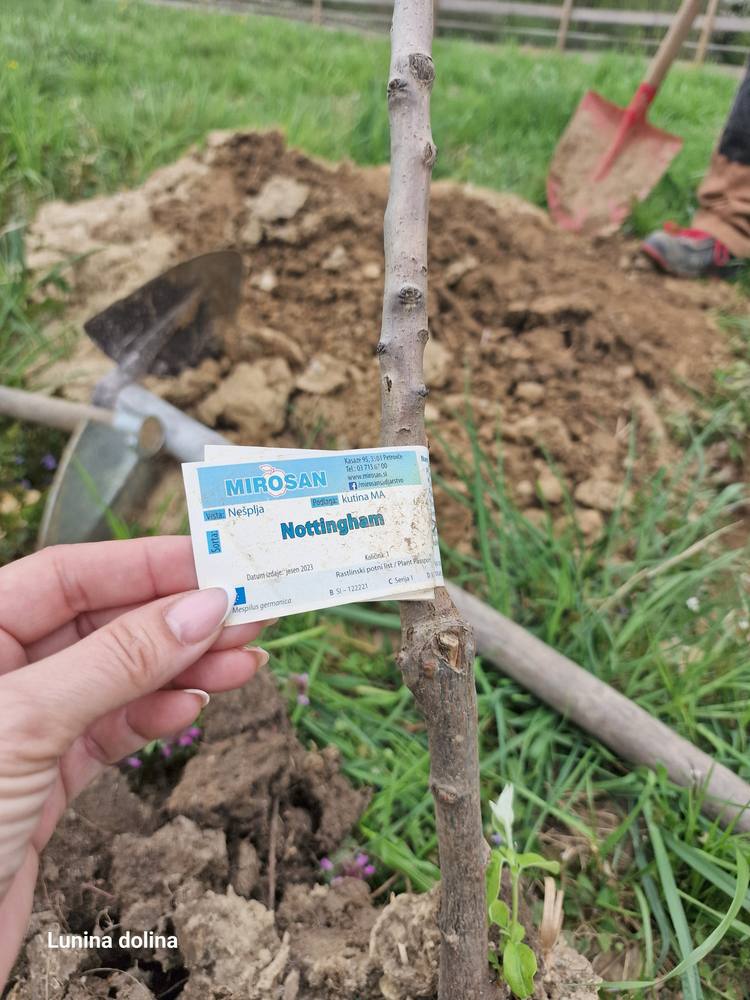
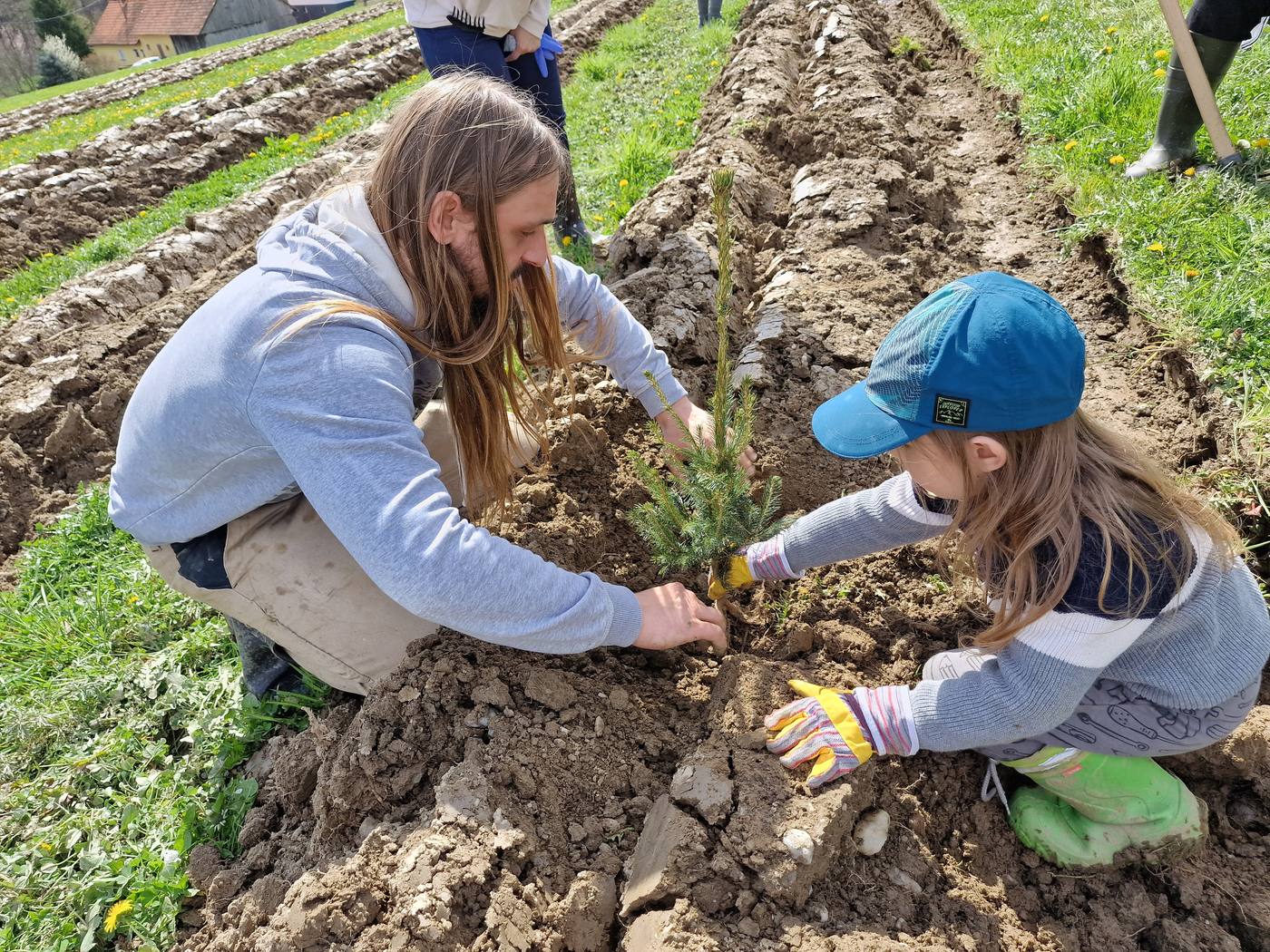
350 trees. 350 small promises to the future.
The first planting was a big step for us: no fewer than 350 trees. Friends, relatives and the Naj Raste team came to help – together we planted them in less than four hours.
Every sapling took planning, choosing the species, buying, preparing the soil, digging the planting hole, planting and caring for the young tree. All of it took a great deal of time, physical work and a considerable financial investment.
But looking at the freshly planted trees was a priceless feeling.
We imagined how they would grow over the years, how their crowns would give shade, their blossoms attract pollinators, their fruit feed people and animals, and their roots help build healthier, more living soil.
In our minds, we could already see the future of this place.
But nature had plans of its own.
When welcome residents become an unexpected challenge
When we stopped regularly cultivating the field and turning the soil, the conditions for life in the soil began to change as well.
That was, after all, one of our goals. We wanted less disturbance of the soil, more plant cover and more room for the organisms that live below the surface.
But there was one thing we were not prepared enough for. Voles.
Without regular tillage, the voles found much better conditions for their underground life there. Their population grew sharply. And the young roots of our trees became their food.
At first we noticed a single tree that was no longer sprouting well. Then a second. And a third.
Some began to wilt, others dried out. With some, we only realised what had happened when we looked at the roots. The voles had damaged them so badly that the trees could no longer survive.
When planting, we had been aware of the risk and protected some of the saplings with special root baskets. But with 350 trees, buying the saplings and all the materials was already a big financial bite. At the time we simply could not afford to protect every tree.
We hoped the unprotected trees would also have a good enough chance to grow. Sadly, it did not work out that way.
And as if that were not enough, new challenges appeared.
When trees also become a home for wild animals
At Lunina dolina we often have visitors from the nearby woods. Among them are roe deer – does and bucks.
We were always glad to see them. We loved that wild animals come onto our meadows and find their place in the landscape we are shaping.
But the young trees were attractive to them, too.
The does nibbled the young shoots, and the bucks rubbed their antlers against some of the saplings. In doing so they damaged the bark and sometimes the whole young trunk.
A tree we had carefully planted, watered and watched grow could be damaged beyond repair in a very short time.
And so the losses grew. Some trees to the voles. Others to the deer.
And with every tree we lost, a small part of the future we had imagined so vividly disappeared as well.
Admitting disappointment
We will not hide it. We were disappointed. Very.
Not only because of the money we had invested. And not only because of all the hours of work, digging, planting, watering and planning.
What hurt most was that we had put so much hope into this place. We planted every tree with the thought that one day it would be big and strong and become part of something bigger.
And then we watched as we lost them, one after another.
In moments like that, you start asking yourself whether you did something wrong. Should we have planned differently? Should we have planted fewer trees and protected them better? Should we have foreseen what would happen once the use of the land changed?
Today we know we could have done some things differently. But back then we made our decisions based on the knowledge, experience and means we had.
And that, too, is part of our story.
Nature does not know our plans
Over time we began to look at what was happening from another angle as well.
When we create the conditions for more life, we cannot choose only the animals and organisms we like or that are useful to us. If we want more diverse nature, we also have to accept its unpredictability.
The voles did not come to destroy our trees. They simply made use of conditions that suited them.
And where there is more prey, predators may eventually appear too. Foxes, buzzards, owls, weasels and some snakes feed, among other things, on small rodents. Their presence can help keep rodent numbers in balance.
But here, too, nature is not as simple as we would sometimes like it to be.
The fox that can help reduce the number of rodents can at the same time be a danger to our hens. The bird of prey we love to watch over the meadow is not there to guard our saplings. It is there because it is looking for food and a place to live.
Nature does not think about our investments, costs, plans and expectations. Every animal is trying to survive.
And if we want to work with nature, we have to understand that too.
Regeneration does not mean doing nothing
Through all of this, we came to an important realisation.
Regenerative farming does not mean simply leaving the land to nature and expecting everything to sort itself out.
Natural processes are extremely important, but they are not always aligned with the goals we have as stewards of a farm.
Young trees need protection. Hens need a safe shelter. Sometimes we have to prevent damage, other times change the way we plant or find a completely new solution.
What matters is understanding why something is happening, and trying to act in a way that does not disrupt natural processes unnecessarily.
That is why we think differently today. We observe more carefully, plan protection for the trees and think about how to adapt individual parts of the farm so that plants, wild animals and our farm animals can live there side by side.
We have learned that sometimes it is not best to do the most, but to do as much as you can maintain and protect in the long run.
And above all, that you have to leave room for change.
The Jungle is still growing. And we are growing with it.
Despite the losses, our Jungle is not a story of failure. It is a story of learning, perseverance and new beginnings.
Some trees survived; others have sadly become part of our experience. But the wish to create a diverse, living place on the former field has not gone away.
So in 2026 we rolled up our sleeves again. Snowy mespilus and cornelian cherry have found a new home in the Jungle.
Perhaps less familiar plants to many people, but for exactly that reason especially precious to us. In spring their blossoms will offer food to pollinators, and later their fruit will delight birds, other animals and us as well.
We are no longer as impatient as we were at the start. Today we understand better that diversity is not created overnight, and that every new planting also brings responsibility.
We still plan, plant and dream. But more and more we are also learning to observe, to listen and to accept that nature will not always follow our ideas.
And perhaps that is the biggest change of all.
When we planted the first 350 trees, we thought mainly about what the Jungle would look like one day. Today we are just as interested in everything that happens on the way there.
Life in the soil. Birds that return. Plants that appear by themselves. Animals that surprise us, sometimes delight us and sometimes set us a new challenge.
We are learning that regeneration is not a contest in the number of trees planted. It is long-term care for a place and the life within it.
And even though we did not manage to keep all of the first 350 trees, we kept something that may be even more important. The wish to try again. This time with more experience, a little more patience and even more respect for nature.
So the Jungle keeps growing. Perhaps more slowly than we first imagined. Perhaps a little differently. But still in the direction we believed in from the very beginning.
Because we do not restore nature only through what we plant. We also restore it through what we learn from it.
Romana and Matjaž
The whole story of Lunina dolina is on the page Our Story.