More than just an egg
Why we decided to keep more laying hens and what a pasture egg means to us.
An egg is one of the most ordinary things in the world. In the morning we crack it into a pan, mix it into dough and barely notice it.
But behind every egg there is a hen. And behind every hen there is a life – of one kind or another.
When we decided to keep more laying hens at Lunina dolina, we did not just want to offer farm eggs. We wanted every egg to stand for a life we could honestly call a good one.
Why more hens?
The decision grew out of a simple wish: to be able to offer farm eggs to people around us – eggs where they know where they come from and how the hens that laid them live.
At the same time, we knew that more hens also meant more responsibility. More space, more care for their health, more work protecting them from predators. And above all, a decision about how these hens would live.
What the words on the box tell us
When we looked into how eggs are labelled, we noticed something interesting: words often create a different picture in people's minds than the reality.
Every egg sold in shops carries a printed code, and its first digit tells you the farming method: 3 means enriched cages, 2 barn, 1 free range and 0 organic.
"Barn" sounds homely – we picture a barn, straw and hens wandering about freely. In reality it means the hens live inside a closed building with no access to the outdoors. They can move around the barn, but they never see grass, sun or sky.
Free range means the hens have access to an outdoor run during the day. How often and how far they actually use it, though, depends on the size of the flock, how the run is laid out and whether they find cover and food there. Large flocks often stay close to the henhouse.
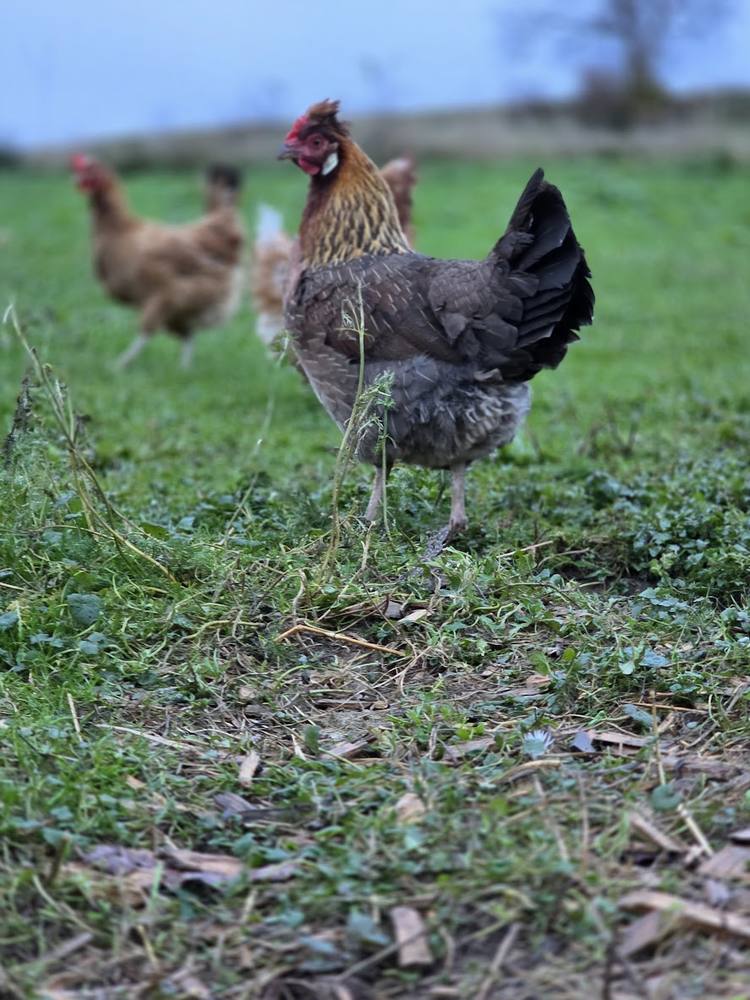
We chose to keep our hens on pasture. It has no number of its own on the egg stamp, but for us it means something very concrete: during the day the hens are out on the grass, among plants, where they can scratch, look for insects, worms and seeds, dust-bathe and warm themselves in the sun.
A hen that can be a hen
Anyone who watches hens on a pasture soon sees how busy they are. They scratch with their feet, turn over leaves, chase grasshoppers, peck at grass and herbs. They look for shade under shrubs and bathe in dry soil to clean their feathers.
This is not just a pretty sight. It is their natural behaviour – what hens are made for. A hen that can scratch, peck and explore is under less stress.
And hens on pasture do not only take. They help the soil too: when they scratch, they loosen the surface, pick up larvae and slugs, and with their droppings they return nutrients that plants need.
What is inside a pasture egg
Many people notice that eggs from pastured hens have a darker yolk. Its colour depends mainly on what the hens eat – green plants, herbs and other natural foods they find in the grass.
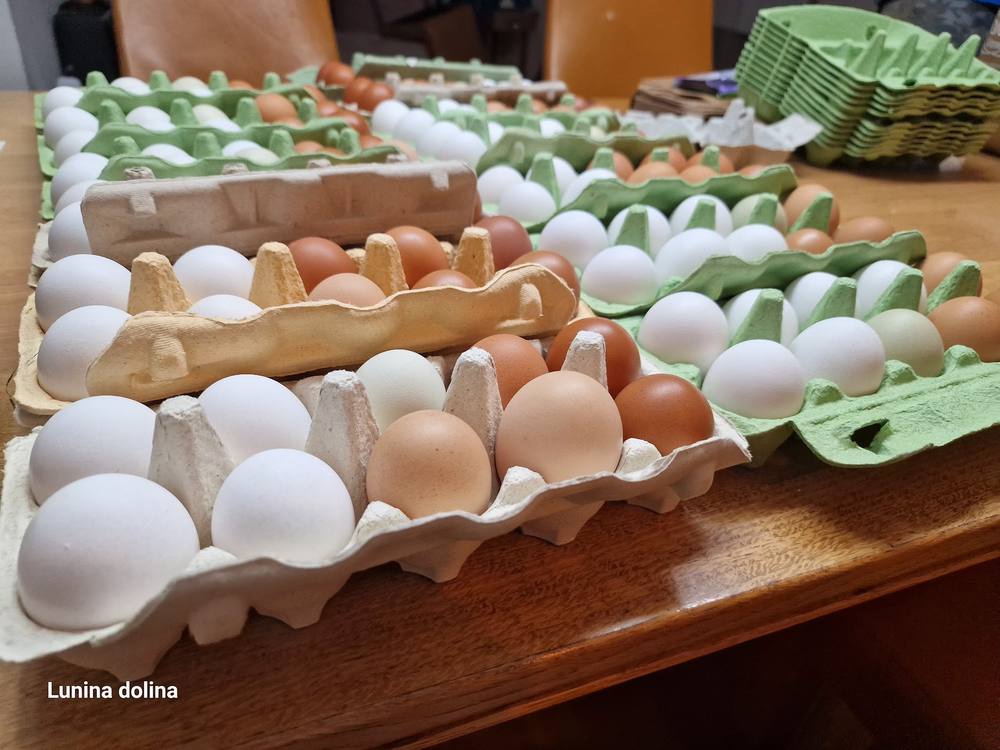
On our egg trays you will find different colours – white, brown and cream. Each colour belongs to a different breed. Among them are the creamy-white eggs of our Styrian hens – it was an egg just like this that, in the story "The egg that became a treasure", became a little girl's greatest treasure.
But for us a pasture egg is not special because of the colour of its yolk or shell. It is special because of what stands behind it.
Safety is never enough
A hen on pasture has more freedom – but she is also more exposed. At Lunina dolina we are not alone: there are foxes in the nearby woods, birds of prey circle over the meadows, and at night other predators come out too.
We will not sugar-coat it: we have had problems too. A marten once squeezed through the wire fence into the henhouse. A morning like that stays with you – and teaches you that protection is never something you set up once and for all.
So we keep improving it. We are trying an electric fence around the hens' housing, and we are getting help from other animals too: geese and guinea fowl are loud, alert animals that quickly raise the alarm when danger is near.
This, too, is part of keeping hens on pasture, even if it is rarely talked about. More freedom for the hens means more responsibility for the people.
What an egg means to us today
Every day, when we collect the eggs, we remember that this is not something to take for granted. That every egg is the work of an animal – and that in return we owe it a good life.
That also means things the buyer does not see: looking after their safety, a clean henhouse, fresh water every day, and checking on the flock even when the weather is at its worst.
When someone picks up a box of our eggs, we hope they see more than food in it. That they see the meadow, the sun and the scratching in the soil – and a hen that got to live like a hen.
What matters is not only what an animal gives us, but also what kind of life we give it.
Romana and Matjaž