From fear to trust
Why we chose Jezersko-Solčava sheep and how we slowly earned their trust.
When we walk onto the pasture today, the sheep often notice us before we notice them. They lift their heads, one bleats, then another – and they are already coming towards us.
A welcome like this was not always a given. At the beginning it was quite the opposite: whenever we came close, they turned and hurried off to the far end of the pasture.
This is a story about how we chose the animals for Lunina dolina – and about how long the road from fear to trust can be.
Why sheep and not goats?
When we were thinking about which animals could help us care for the meadows, we weighed up sheep and goats. Both suit smaller farms, but they eat in very different ways.
Goats are browsers by nature. They prefer leaves, shoots, shrubs and bark, nimbly stand up on their hind legs and reach higher branches too. On a farm where we had planted hundreds of young trees, that could have meant a lot of damage.
Sheep are mainly grazers. They find most of their food close to the ground – in grass and herbs – and strip far less bark from trees than goats do.
That does not mean young trees need no protection around sheep. A sheep will happily try a fresh shoot if it can reach it. But for a place where we want trees and animals to live together over time, sheep were the more sensible choice.
Why Jezersko-Solčava sheep in particular?
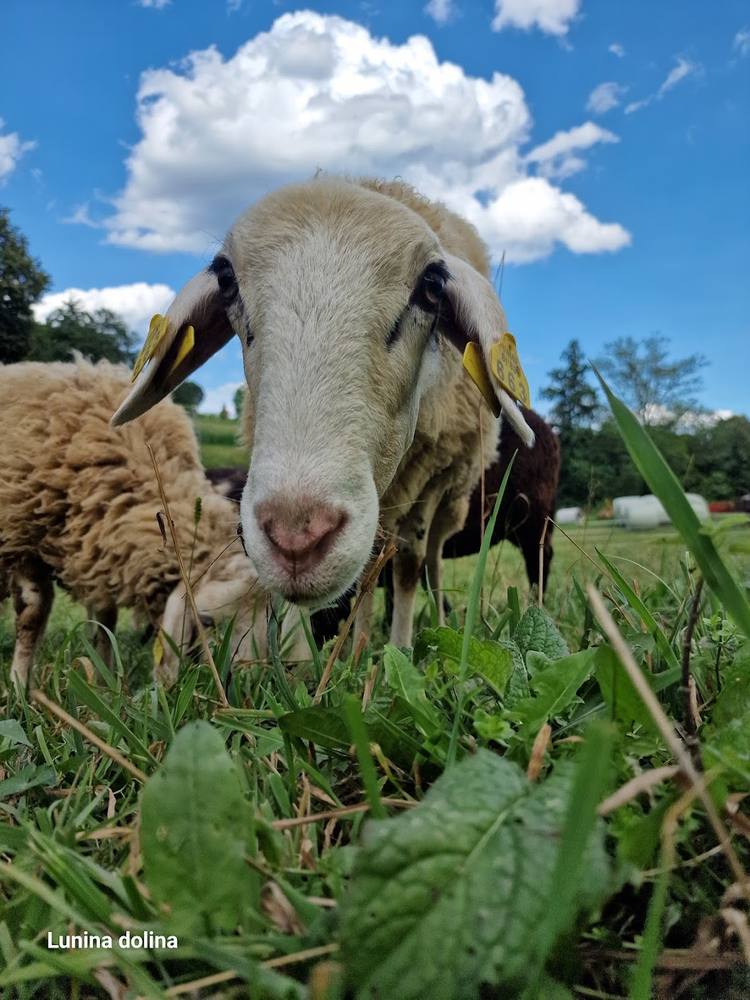
We chose the Jezersko-Solčava sheep – a native Slovenian breed that comes from the mountains around Jezersko and Solčava.
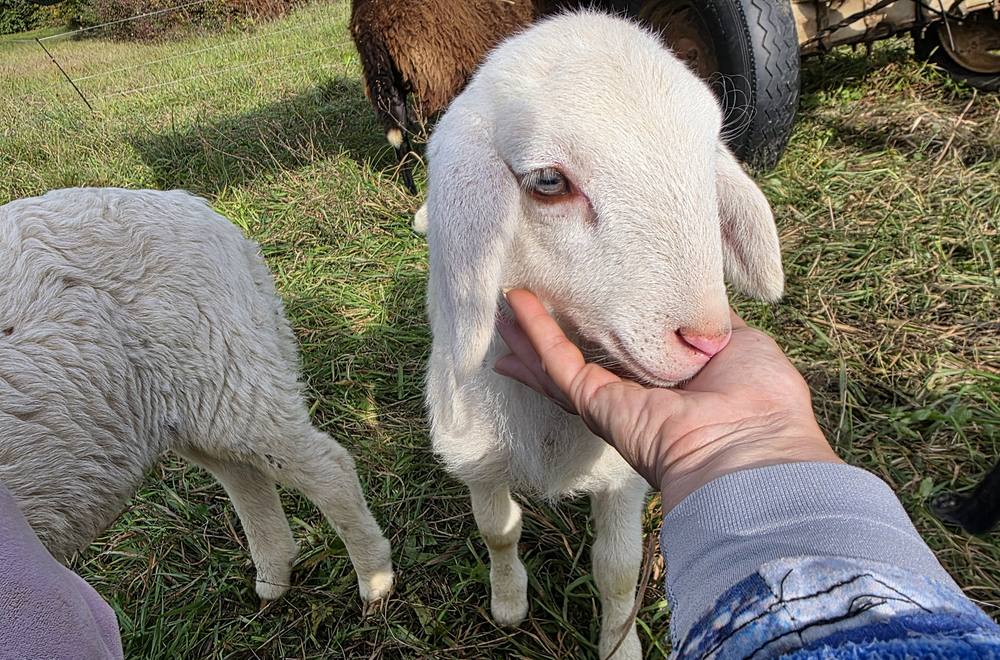
It is a modest, hardy and adaptable breed, used to grazing and changeable weather. You can recognise it by its long, drooping ears. The ewes are good mothers and can lamb all year round, not only in one season.
But the decision was not only about the breed's qualities. Native breeds are part of our heritage. They developed over centuries, together with the people and the landscape they lived in. If they disappear, a piece of knowledge and diversity disappears with them that can never be brought back.
It felt right that we, too, when we have the chance, should make our small contribution to preserving them. Not as a big project, but simply by giving them a home.
Wool that is not waste
The Jezersko-Solčava sheep is not a breed for fine wool. Its wool is coarser and often has no real market value, so in many places it goes unused.
We use it in the garden and around the trees we have planted. Laid on the ground, it works as a mulch: it holds moisture, holds back weeds and protects the soil from drying out. As it slowly breaks down, it returns nutrients to the soil.
So the circle closes on the same land: the sheep graze the meadows, and their wool helps the trees grow that will one day give them shade too.
When they ran away from us
Our first weeks with the sheep were a lesson in humility.
We had imagined walking among them, stroking them, and that they would quickly get used to us. The sheep had other ideas. As soon as we stepped onto the pasture, they huddled together and moved away. If we took one step towards them, they took two away.
Today we understand why. Sheep are prey animals. For centuries their survival depended on caution – on sticking together and fleeing before it is too late. A person who approaches quickly is a danger to them first, however good their intentions.
That was when we began to understand that we had to change ourselves, not them.
Slowly, every day again
We started coming every day. Not only when there was work to do, but also when we just wanted to look at them. We moved slowly and calmly and spoke in quiet voices.
Feeding made a big difference. The sheep soon learned that people meant something good. At first they would only eat once we had stepped back. Then while we stood to one side. And one day the first one took food straight from a hand.
We started calling them by their names. It may sound unusual, but sheep recognise the voice and the tone you call them with. A name said the same way every day becomes a sign: this is someone I know.
Small steps like these went on for weeks and months. There was no single moment when everything changed. Trust grew quietly, almost unnoticed.
Why trust matters so much
For us, trust is not just a nice feeling. It is essential for everyday work.
We regularly move the sheep to fresh pastures. That way the grass on the grazed area can recover, and the sheep keep getting fresh grazing. And because they trust us, we do not have to chase, drive or upset them. Usually it is enough to open the gate and call them – and they follow us.
A flock that calmly follows you to a new pasture means less stress for the animals and less work for people. It is also the best proof that the relationship we have built is real.
Today they run to meet us
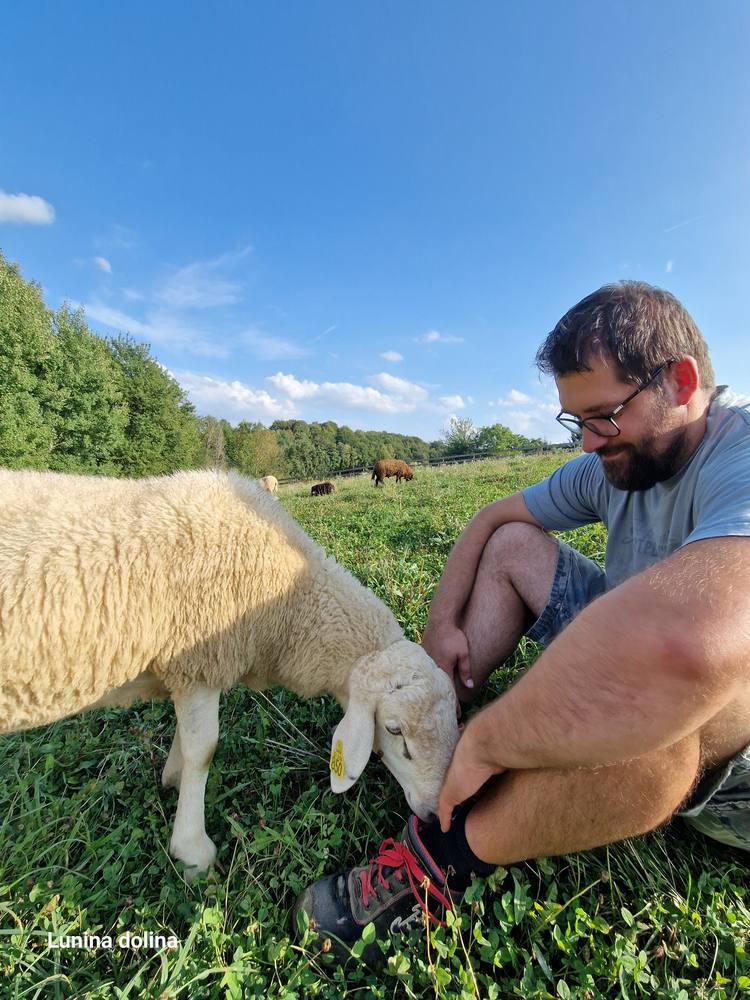
Today the picture is completely different. When they see us, many of them run to the fence. Some let us scratch them behind the ears, others nudge us gently with their muzzles, as if to say they have noticed us. Among the most trusting are Erika, Pikica and Špelca – the lambs we raised on the bottle, whose story is told in "Three bottles and sleepless nights".
Yet they are still sheep – wary of a sudden noise, strangers or a dog. And that is how it should be. We never take their trust for granted.
Every time one of them comes closer on its own, it is a small gift. And a reminder that we had to earn it.
That is why we like to tell our visitors: do not chase them. Crouch down, wait, and let them come to you. Most of the time, they do.
You cannot demand an animal's trust. You can only earn it, little by little.
Romana and Matjaž